|
Home The FORK-ALIGNER From Performance Design
|
||
|
More Detailed Information It's been proven over and over again that a bike even after simply falling over from a standing position, often will cause the forks to slip in the triple trees slightly (and sometimes a great deal), causing a 'tweaked' or slightly twisted position. This doesn't mean they are necessarily bent, but the top part of the tree has gone one direction and the bottom the other. This is so slight it is difficult to detect, unless it is enough to cause the clip-ons, or handle bars to be off enough that you can see it. Surprisingly, many bikes are that far out. The more 'off' it is, the more the forks will bind when they compress and get shorter overall. Many times when at full extension, the forks flex enough to keep things within reason, but as they compress it can be a whole different story. If you remove the front wheel and let the forks 'relax', the condition becomes much more apparent, because the axle is forcing the bottom to try and stay straight, but obviously this will keep the suspension from working smoothly if off enough. Almost any mechanic, experienced suspension tuner, or true racer, knows this happens. Till now there was not any accurate, affordable, or convenient way to do a quick check. Many bikes are even out of align from the dealership or factory.
When this condition is present for the racer, it can be a nightmare to get the suspension 'just right'. The mechanic can keep making dampening, or preload adjustments, without much effect, then all of a sudden an adjustment is made and there is too much of a change, then they have to chase it around again. The suspension will usually work fine enough for the everyday street rider, who really doesn't need to know suspension set-up, and doesn't really care about precise handling. But for the serious street rider or obviously the racer, it matters alot! When a bike is worked on, or prepped for its original sale, it certainly should matter. How It Works
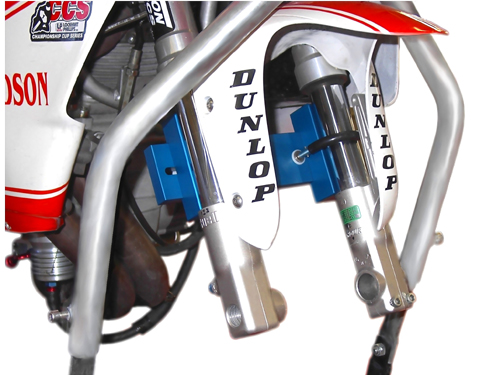
The 'V-Block' end is placed on the moving part, (the
inner telescopic part) of the forks. The specially designed spring loaded
hook then is pushed in, and rotated around to the backside of one slider
and released. This
holds the unit in place while you do your checking and straightening if
needed. The hook attachment is even designed to go behind the plastic fork
protectors without even moving them out of the way. |
||
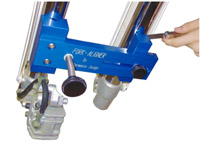 You
simply then adjust the other end piece so that the flat part of it
contacts the other fork leg as shown in the photos. You pivot the tool on
the 'V-Block' end till the adjustable end lightly makes contact with the
other fork leg then look for any gap at the top or bottom of the
adjustable end piece. The tension the spring puts on the other end
allows you to pull the top or bottom of the adjustable end into the
tube to see if you get any rocking action, due to a
You
simply then adjust the other end piece so that the flat part of it
contacts the other fork leg as shown in the photos. You pivot the tool on
the 'V-Block' end till the adjustable end lightly makes contact with the
other fork leg then look for any gap at the top or bottom of the
adjustable end piece. The tension the spring puts on the other end
allows you to pull the top or bottom of the adjustable end into the
tube to see if you get any rocking action, due to a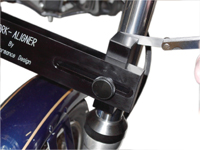 slight gap.
Then on that extremely rare chance that both tubes are bent the same, you
simply rotate one leg of the fork, by grasping & rotating it by hand.
If they are conventional forks, you loosen one tube at the triple tree
& rotate. If they were bent back extremely even, rotating will make
the bent part go forward, thus making it easy to spot. We have never seen
a case where both tubes bent perfectly even though. The
crossbar is made rigid enough so you can do this without twisting the tool
itself, you
can see and feel even .005 or .006 gap quite easily. We do include a
set of feeler gauges in the kit to check the gap with. The F.A. works on regular or
inverted forks equally well. The actual overall design of the tool, is
also to make working around brake lines, etc... possible. It works equally
well on aftermarket or OEM fork, for all types of motorcycles.
slight gap.
Then on that extremely rare chance that both tubes are bent the same, you
simply rotate one leg of the fork, by grasping & rotating it by hand.
If they are conventional forks, you loosen one tube at the triple tree
& rotate. If they were bent back extremely even, rotating will make
the bent part go forward, thus making it easy to spot. We have never seen
a case where both tubes bent perfectly even though. The
crossbar is made rigid enough so you can do this without twisting the tool
itself, you
can see and feel even .005 or .006 gap quite easily. We do include a
set of feeler gauges in the kit to check the gap with. The F.A. works on regular or
inverted forks equally well. The actual overall design of the tool, is
also to make working around brake lines, etc... possible. It works equally
well on aftermarket or OEM fork, for all types of motorcycles. |
Used on
Sportbikes Off-Road, Etc. |
|
Used on Cruisers |
136 Airport Road
Headland, Al. 36345
1-334-693-9203